Chef Eugenio Gasca: Teaching and continuing to learn

Passion, technique, and persistence: the keys to a chef who never stops learning.
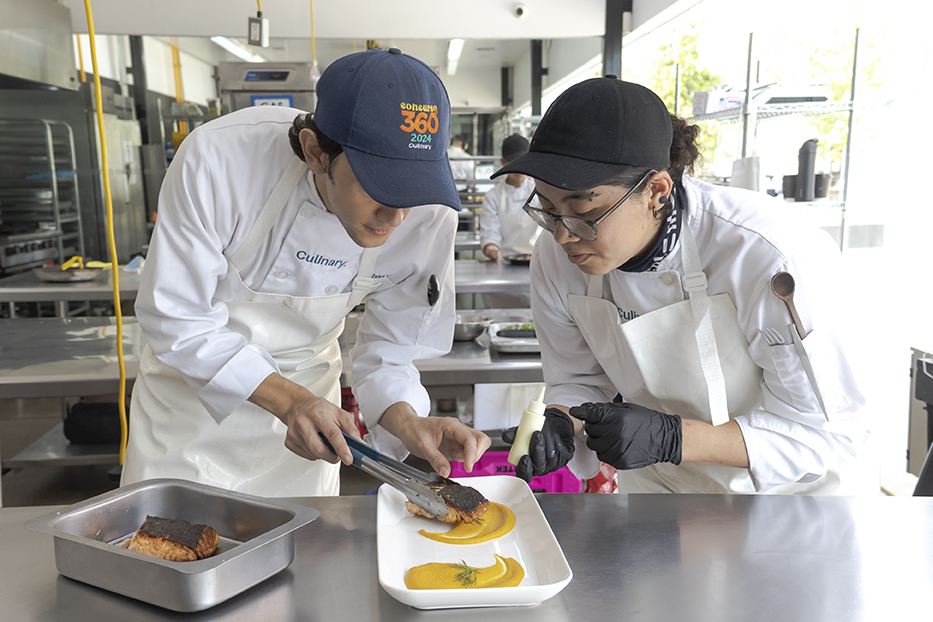
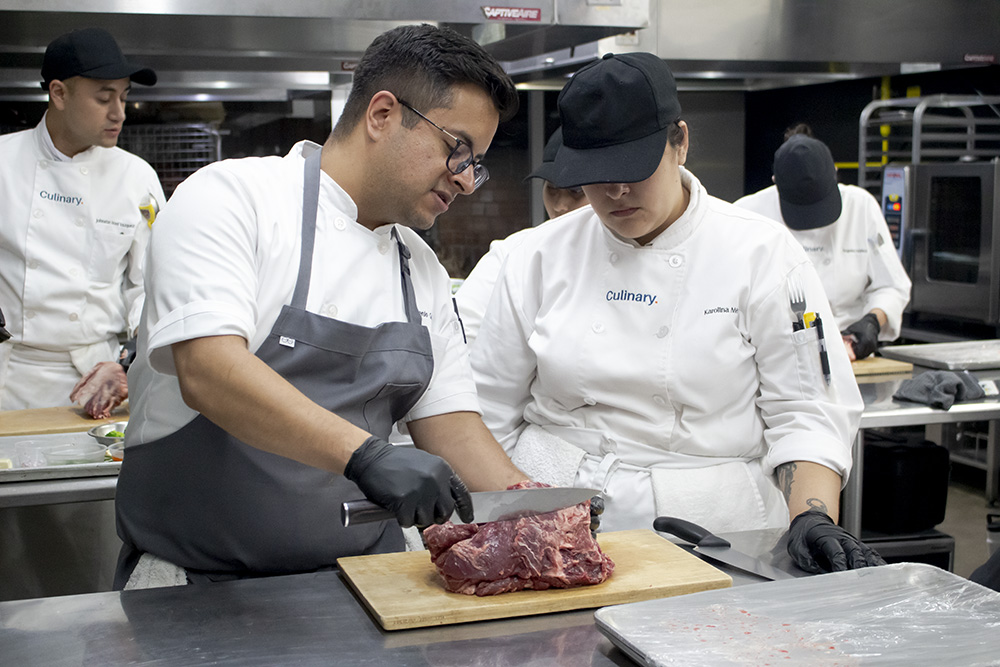
Chef Eugenio Gasca has been a Culinary instructor for four years, teaching courses such as Culinary Basics, Culinary Arts, Cuisines of the Americas, Culinary Techniques, and Old World Cuisine, among others. His beginnings in Mexico City provided the foundation for what has been a journey of knowledge, spontaneity, pride, and humility.
With a career highlighted by his roles as sous-chef at the renowned restaurants Nicos, by Chef Gerardo Vázquez Lugo in Mexico City, and Anajak Thai, in Los Angeles, California; as a chef de partie at the restaurant Bodegón Alejandro, in San Sebastián, Spain; and as a cook at the restaurant Otium, also in Los Angeles, California; he has worked to overcome the self-imposed challenges that give purpose to his career and life.
In this interview, he highlights his vision of cooking as an act of affection, his patience as an educator, his positive outlook as an instructor, his perfectionist streak, and his drive to be better.
Upon meeting him, his enthusiasm and relaxed demeanor are evident, contrasting with his professional composure and commitment to his chosen craft. It is clear that he takes pride in his spontaneity in the kitchen and the time he dedicates to refining his technique—something he knows he will always strive to improve.
Let's start: when did you get into this, and why did you choose cooking as a profession?
Well, I started over 10 years ago; I studied at Ambrosía in Mexico City. As for why... I think I have the typical sentimental story where I watched my grandmother and my mom cook, and tasting their dishes sparked my curiosity. Although, I must say that more than just good food, I’ve always loved the feeling of being able to show affection to someone through cooking.
You grew up in an environment where there was a love for cooking and food as a sign of affection; did that inspire you to pursue a career in it?
Yes, definitely. Plus, I grew up with the habit of going out to eat at a new place every weekend—good places—and eating all kinds of food from all over the world. I think that really helped my palate and my curiosity.
And once you finished your studies and entered the job market, what was your first experience like? Did you enjoy it? Was it what you expected?
My first work experience was when I started school and went on an internship. When you start, it's a shock because you realize that school teaches you in a way that helps you understand processes and protocols in a kitchen, but the reality is that many things are often skipped because the demand and pressure are different; time is money there.
That surprised you, but... did you like it?
It made an impact on me, and I liked seeing the reality, although it was also disappointing to see that the processes we are taught in school are often not respected. It was hard to overlook that, because I believe that when something needs to be done, it should be done right—always.
And digging a little deeper, why did you choose this specialty? Why savory cooking?
I like savory cooking more because I feel it's a bit more flexible; it gives you the chance to experiment a little more. I see savory cooking as an opportunity: you have the foundations and the technique, and with those, you can reach a result in many different ways.
Do you think savory cooking fits your personality better?
Yes, it gives me the chance to experiment more, to be very, how should I put it... Spontaneous! I think that would be the word that defines it best.
And if you like all this spontaneity, experimentation, and fast pace... why did you decide to start teaching, when teaching is a job involving repetitive content?
As it turns out, I didn't choose it.
You didn't? How did that happen?
Well... as fate would have it, not only did the opportunity present itself, but the truth is I always wanted to teach, because I think my good teachers left a mark on me, and they are the ones I remember.
You still remember them with admiration and gratitude...
Yes, I see it that way, because when I was interviewed for this job and they gave me the chance to see the recipes I was going to teach at the school, I realized there were things I hadn't done in a long time, but I felt confident that I could replicate them because I had a good education.
So your motivation was to be able to create those good experiences you had as a student...
Yes, and also, very importantly: the challenge. I have always lived my life as a series of challenges that I want to achieve.
What was the challenge you saw here?
Realizing that I can teach and do it well.
Was it a goal to be met?
Yes, it was a goal, a box on the checklist. I thought, “I’ve worked here, I’ve worked there, I’ve been a head chef, a sous-chef, a chef de partie…,” it was time to try the academic world, and now, I’m happy to see that I can teach.
What experience has left the biggest mark on you as a teacher?
Something you mentioned that’s quite funny is that it’s very repetitive, and you’re absolutely right because you teach the same recipes in the same classes, at the same school, in the same kitchen, over and over again. But the simple fact of being able to teach someone something new in five hours, introducing a student to a dish or a flavor, and being able to do that every day… that’s something I never get tired of. Seeing their look of amazement, hearing them say “wow, this tastes so good,” having them try something they’ve never eaten in their lives—it’s very special, it’s instant gratification.
And coming back to you in the kitchen, do you think that teaching and constantly repeating this dynamic has made you a better cook?
A thousand times over.
With all that repetition, you’ve perfected your techniques…
Definitely, it’s constant practice. In each class, I might make a recipe four times per group; if I have two groups, I can make it eight times in one day, and that gives me the experience and the confidence to keep getting better.
Can you think of a recipe you’ve perfected?
A French omelet . Although perhaps "perfection" isn't the right word; I think the achievement lies in knowing where you can go wrong and being able to fix it before you mess it up. I think that’s as close as you can get to something perfect.
Would you say you managed to break down the process and master the step-by-step?
There’s a phrase that defines it for me: “cooks don’t do one big thing well, we do many small things well.” All those little things are reflected in a dish and define what makes a meal good or bad. That’s what I’m chasing.
Taking that into account, what do you think is a fundamental quality for someone who wants to dedicate themselves to this?
You need a lot of patience, persistence, and humility. You have to know how to listen and write everything down. Writing things down by hand is what has helped me the most.
Do you think it's important to be a perfectionist?
Absolutely. You have to be obsessive and pay close attention to detail.
What do you consider the biggest challenge you face in this profession?
For me, the biggest challenge is staying mindful and reminding myself that my students are still learning. As a chef, you often take many things for granted.
And you want to move faster…
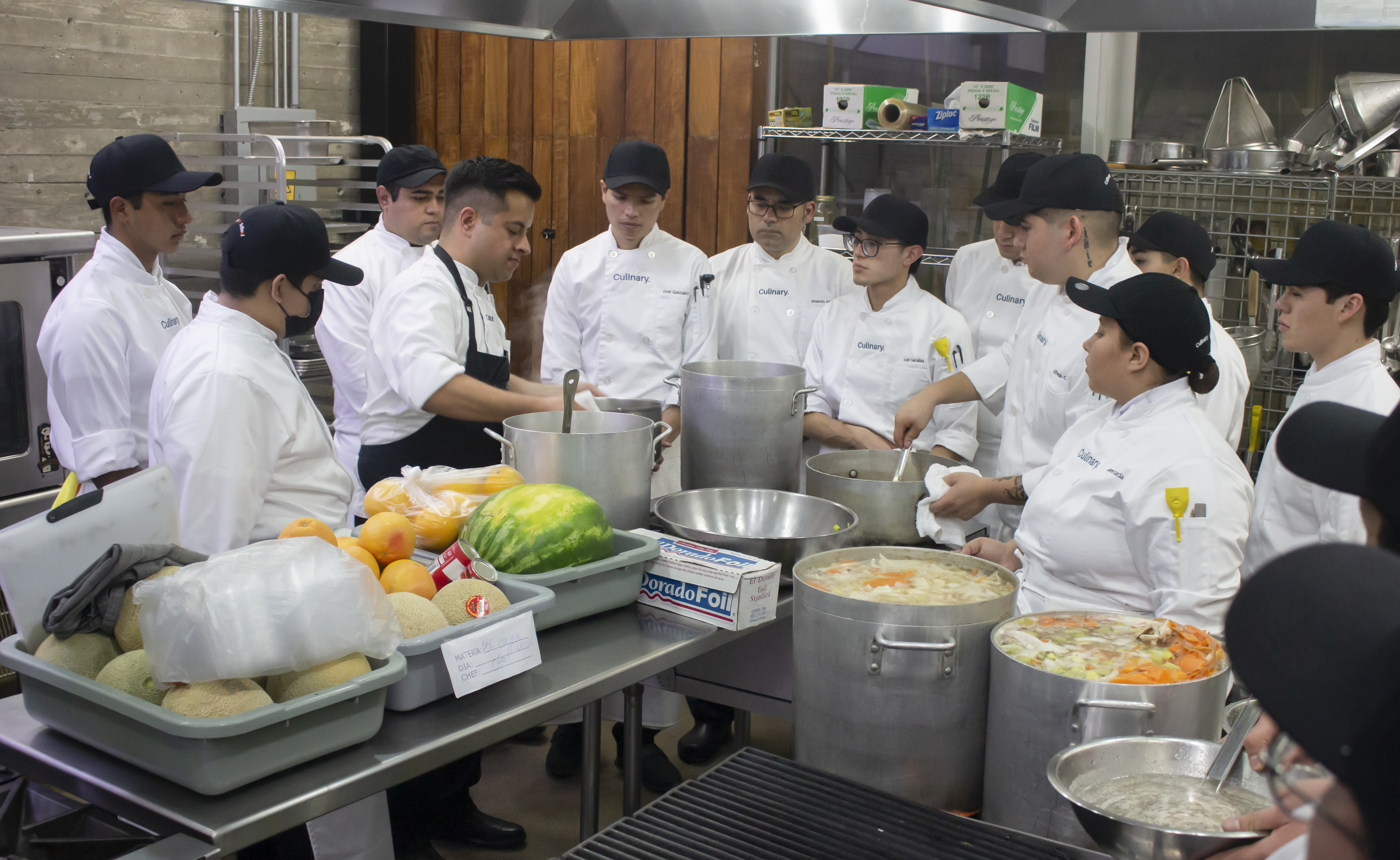
Yes, I can skip certain steps in my head and get things done quickly, but someone new can't. It’s very important for me to remember that you have to be patient. Not everyone learns the same way or at the same pace. Some people can do it just by listening, some need to watch, some need to do it and mess it up before they can get it right, and others get it perfectly on the first try. Being able to identify each student's process and support them is work that brings me great satisfaction.
Speaking of your students, what advice would you give them now, if you haven't already?
Well, to choose a different career—no, I’m just kidding! But in all seriousness, it is a very difficult path.
Seriously though, don't just memorize recipes; learn the technique. That’s what opens doors. If you know the method, you can pick up any cookbook and successfully make a dish you’ve never tried before.
And stay humble. Be like a sponge and always want to learn. Eat a lot and try everything. Keep your hunger—both for food and for knowledge.
How do you see the professional landscape for your students?
I think it’s going to be better for them because it’s easier to interact with people and get what you want. You can just reach out, send a message, and land an opportunity at your dream restaurant. That said, you have to be aware that it’s a tough industry. You’ll likely face mistreatment, low pay, and heavy workloads. You have to be realistic and ask yourself, "Am I willing to endure all of this to reach my goal?"
What do you think is the right answer?
That it’s worth it. I did it, and I would do it all over again.
Is it worth it?
Fortunately, I’ve lived through it and have seen how that famous "old school" mentality has changed a lot. But there are some things that won't change, like hierarchies; those are earned through hard work and sacrifice. In this industry, we have to be extra aware that we are the ones working while everyone else is having fun—in fact, we’re busiest when everyone else is out enjoying themselves. I think for a generation used to immediacy, that kind of sacrifice can be very difficult.
So you have to be aware of the sacrifices this career demands and decide early on…
Yes, I think we can break it down into two things:
The old school was definitely abusive—people would throw things at you. I’m speaking from experience; I lived it. I’ve had plates thrown at me, I’ve been insulted and mistreated. But at the time, instead of letting my pride take over and saying, "I'm out of here," I stopped and thought, "Why am I here, and what am I willing to endure to learn from this person?"
And, most importantly, there’s that first type: people who just yell for the sake of yelling. Then there’s the second type, where they might yell, but in that same breath they tell you, “Okay, you messed up here, now let me show you how it’s done right.” Those are the people I hold in high regard, because they actually teach you.
On the flip side, what do you think has been the most rewarding experience of your career?
I think that ever since I decided to get into the kitchen, everything has unfolded very organically. I used to study marketing and I hated it. From the moment I decided to study culinary arts, even though it’s very demanding and exhausting, I’ve never felt like it was a burden. Sure, you get tired—mentally and physically—but you never get bored.
So, a moment… I don’t know, maybe when I was made sous-chef at Nicos restaurant, that was a big deal for me. Or presenting my food in the United States to people I didn’t know—celebrities and producers—and being able to say, “This is my cooking, this is who I am.” That was a real achievement.
How does it feel when someone enjoys your food?
Oh, it’s a huge sense of pride. You feel like you’re on cloud nine because it’s something you can’t lie about or fake; you either like it or you don’t, period. And when someone is speechless because of how good it is, or when someone’s eyes fill with tears because you reminded them of their grandmother, when you manage to connect with their nostalgia, you’ve already won. That’s when you know you’ve made it.
.
Talking with Chef Eugenio Gasca makes it clear that teaching is also a way to keep learning, and that success is tied to consistency and dedication—aspects that are undoubtedly vital for anyone looking to build a career in the culinary world.
If you feel inspired by this interview and would like to know more about the Bachelor’s Degree in Culinary Arts, click here.